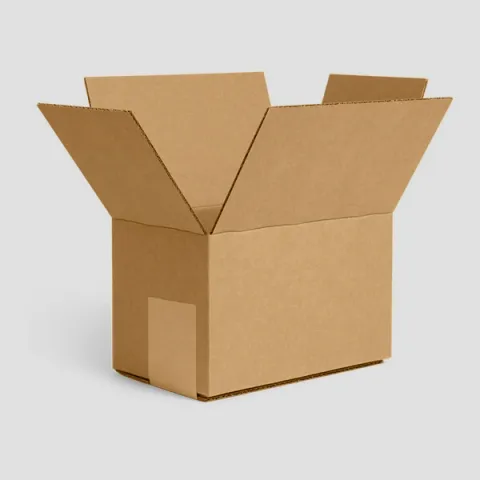
Why Is the Inside Size the One That Counts?
Your product lives inside the box, so the inside measurement is the one that decides whether it fits. The outside size depends on the board: a double wall box with the same inside size as a single wall box is several millimetres larger on every side. Box makers quote on the inside so that the fit is right whatever board you choose.
If you only know the outside size you need, for example because the box must fit a shelf or a courier size band, tell us that limit. We work back from it to the largest inside size the board allows.
Which Order Do the Measurements Go In?
Box sizes are always written as length × width × height. The order matters, because it tells the maker which side has the flaps.
- Length: the longer side of the opening
- Width: the shorter side of the opening
- Height: the depth, from the base to the opening
So a box written as 400 x 300 x 200 has an opening of 400 by 300 mm and is 200 mm deep. Swap the order to 400 x 200 x 300 and you get a taller box with a narrower opening, which packs very differently.
How Do You Measure the Product?
Measure the item at its widest points in each direction, including handles, caps, feet and anything that sticks out. Use a rigid ruler or a steel tape for accuracy; a soft tailor's tape bends around corners and adds error.
- Place the item as it will sit in the box, with its opening face up.
- Measure the longest side across the top: that is the length.
- Measure across at right angles: that is the width.
- The distance from the base up to the tallest point gives you the height.
- Write the three figures down in that order, in millimetres.
How Much Room Should You Leave?
That depends on how the item is protected. A rigid product that cannot be scratched can sit almost against the walls. A fragile one wrapped in paper or bubble needs space for that wrapping on every side.
| Product | Allowance each side | Example |
|---|---|---|
| Rigid, sturdy, unwrapped | 2 to 3 mm | Boxed goods, books, tins |
| Lightly wrapped | 5 to 10 mm | Clothing in a bag, homeware |
| Fragile, well padded | 20 to 30 mm | Glass, ceramics |
| Inside an inner box | 2 to 5 mm around the inner box | Retail packs in a shipping carton |
Remember that the allowance applies to both sides, so a 10 mm allowance adds 20 mm to the length and 20 mm to the width.
What If You Are Packing Several Items?
Arrange them exactly as they will be packed, then measure the whole group. Items laid side by side, stacked or packed upright give very different sizes. Try a couple of arrangements: the one that fills a neat rectangle with the least empty space usually makes the best box.
For bottles or jars, a divider grid inside the box keeps them apart. In that case, measure one item and count how many go in each row and column; we size the grid and the box together.
How Accurate Do You Need to Be?
To the millimetre for small boxes and close-fitting cartons, where a few millimetres is a large share of the space. For large boxes with plenty of padding, the nearest 5 mm is fine. If a measurement falls between two figures, round up: a box a millimetre too big still closes, one a millimetre too small does not.
What About Inch Sizes?
Many common UK box sizes started life in inches, which is why you see figures such as 305 x 229 x 152 mm (12 x 9 x 6 inches). If your old boxes or your racking are in inches, convert by multiplying by 25.4 and round to the nearest millimetre. We work in millimetres throughout.
Checking the Size Against Delivery Costs
UK parcel prices depend on size as well as weight. Once you have an inside size, add the board thickness on each side to estimate the outside size, then check it against your carrier's size bands. A few millimetres off the height can sometimes move a parcel into a cheaper band. The table of popular box sizes lists sizes that work well for common parcels.
Common Measuring Mistakes
Most sizing problems come from a handful of simple slips. Checking for them before you send a size saves a reprint.
- Sending the outside size of an old box as the inside size
- Swapping width and height, which turns a low box into a tall one
- Forgetting a cap, pump, handle or plug that sticks out
- Leaving no room for wrapping on a fragile item
- Measuring a soft product squashed rather than relaxed
Measuring an Existing Box You Want to Copy
If you already use a box that works, measure its inside rather than its outside. Open it out, close the bottom flaps as they would be when packed, and measure between the inner faces of the walls. For height, go from the inner floor to the top crease line, ignoring the flaps above it.
If the box is a style you are not sure how to describe, take a photo of it open and closed and send it with the measurements. We can usually identify the style from that and match it.
What Should You Send Us?
The inside length, width and height in millimetres, the quantity, and a line about what goes in the box. If you are unsure, send the product size instead and say how it will be protected; we will add the allowance and confirm the box size on the quote.