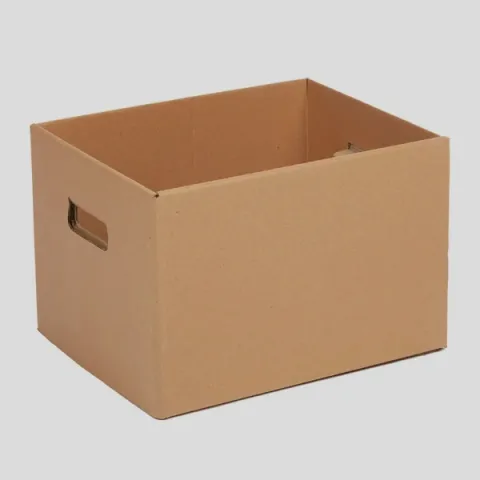
What Is a Flute?
Cut a piece of corrugated board and look at the edge. Between the two flat sheets you will see a wavy layer of paper: that is the flute. Its arches work like a row of tiny columns, resisting crushing and giving the board stiffness. Taller arches make thicker, more cushioning board; smaller arches make thinner, smoother board.
Why Are the Letters Out of Order?
Flutes were named in the order they were introduced, not by size. A flute came first and is now rarely used in the UK, then B, then C, then E. So the alphabet is no guide: C outmeasures B, while E is the slimmest of the everyday options. It is confusing, but once you know the sizes the letters make sense.
How Do the Common Flutes Compare?
Thickness varies a little between mills and liners, so treat these figures as a guide rather than a specification.
| Flute | Approx. thickness | Character | Typical use |
|---|---|---|---|
| E | 1.5 mm | Thin, smooth, prints sharply | Mailers, postal boxes, retail packs |
| B | 3 mm | Firm, resists punctures | Everyday shipping boxes |
| C | 4 mm | Taller arches, more cushion | Larger parcels, softer goods |
| BC | 7 mm | B and C bonded together | Heavy, fragile, stacked loads |
E Flute: Thin and Smooth
E flute has small, closely spaced arches. The surface is flat enough to take detailed print, and the board folds into tight corners, which is why it is the standard for mailer boxes, postal boxes and small retail packs. It protects better than paperboard, but it is not the grade for heavy items travelling alone.
B Flute: The Everyday Grade
B flute is the workhorse of UK shipping cartons. It is firm, resists punctures from corners and sharp objects, and takes 1 or 2 colour print well. If you are not sure what grade a parcel needs, B flute is a sensible starting point.
C Flute: More Cushion
C flute has taller arches than B, so it is a little thicker and gives more cushioning. It suits larger boxes, softer goods and parcels that benefit from extra give at the corners. It is slightly less resistant to punctures than B, so the choice between the two depends on the contents.
BC Flute: Double Wall
BC stacks a B profile on a C profile and sandwiches them with three liners. The result combines the puncture resistance of B with the cushioning of C, at roughly twice the thickness of either. It is the grade for heavy items, fragile goods, removal boxes and anything stacked on a pallet. Our guide to single and double wall covers when it is worth the extra cost.
How Does the Flute Affect Printing?
Ink lands on the top liner, and with the deeper grades the waves beneath can show as very slight stripes. On E flute the surface is close to flat, so fine detail and full colour print well. On B and C flute, bold shapes and solid colours work better than thin lines. On BC, keep designs simple.
- Fine detail and photos: E flute or paperboard
- Logos and text: any flute
- Large solid areas: B or C flute
- Simple bold marks: BC double wall
Does the Direction of the Flute Matter?
Yes. In a standard box the flutes run vertically, from the base to the opening, because that is the direction that resists stacking load. Turn the same board on its side and it crushes far more easily. This is why a box placed on its side at the bottom of a stack can fail when the same box upright would have been fine, and why pallets are built with every box the right way up.
Flute direction also affects folding. Board bends more cleanly along the flutes than across them, which is one reason die cut shapes and inserts are laid out carefully on the sheet before cutting.
How Does Damp Change Things?
Corrugated board is paper, and paper softens when it absorbs moisture. A box stored in a cold, damp unit or left on a wet floor loses a good share of its stacking strength, whatever the flute. Thicker flutes and double wall keep more of their strength for longer, but no grade is immune. Store flat boxes off the floor in a dry place, and avoid leaving packed boxes outside before collection.
Which Flute Suits Which Box Style?
These are starting points rather than rules. The contents and the journey always come first, and a quick note about both on your quote request is the surest way to get the right grade the first time you order.
- Mailer and postal boxes: E flute, or B for heavier contents
- Everyday shipping cartons: B flute
- Large cartons with soft goods: C flute
- Removal boxes and stacked trade cartons: BC double wall
- Counter displays: E flute with a white liner
- Divider grids: B flute strips
Can Different Flutes Be Mixed in One Order?
Yes, and it is common. A shop might use E flute mailers for small orders, B flute cartons for everyday parcels and BC for the heavy ones, all on a single quote. Each size and grade arrives in its own labelled bundles, so mixing them causes no confusion at the packing bench.
How Do You Choose a Flute?
- Start with the weight and fragility of the contents.
- Consider whether boxes are stacked or travel alone.
- Decide how much print detail you need.
- Pick the thinnest flute that protects the contents.
- Ask for a second grade on the quote if you are torn.